Tour of the display for installers and administrators
If you need to install or maintain the display, take this tour to familiarize yourself with its components:
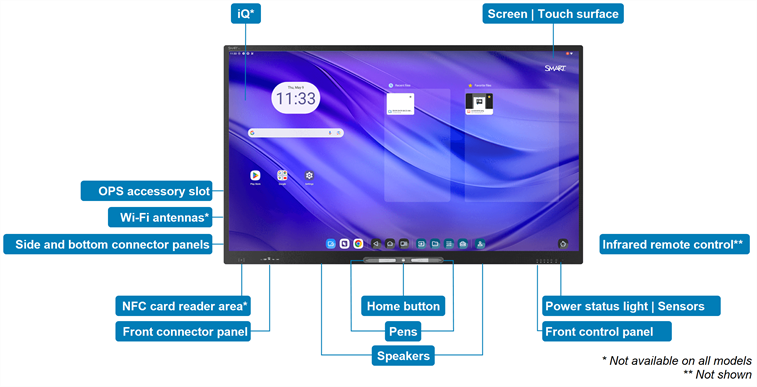
 iQ
iQiQ is the embedded Android operating system on non-high-secure SMART Board M Pro series interactive display models.
iQ runs on Android 13 (or later) and is EDLA-licensed by Google.
When you turn on the display for the first time, you’re prompted to configure iQ.
By default, the display downloads and installs iQ updates automatically. You can also download and install updates manually.
PensThe display comes with two pens, which users can use to write or draw on the screen.
Replace a pen if its nib becomes worn to prevent damage to the screen or impairment of pen and finger detection.
Power status light | SensorsThe power status light indicates the display’s status:
When the power status light is red, the display is in Standby mode.
When the power status light is green, the display is in normal operating mode.
The display includes an infrared sensor that works with the infrared remote control and an ambient light sensor that can detect the brightness of the room and adjust the screen’s brightness accordingly.
You can enable or disable the ambient light sensor feature.
Infrared remote controlWhen you first install and configure the display, you can use the infrared remote control to turn the display on or off, switch inputs, and view and change settings.
After installation and configuration, you can give the remote to users for use with the display.
Home buttonUsers can press the Home button to return to the iQ home screen at any time.
Front control panelThe front control panel contains buttons for turning the display on and off, controlling the volume, freezing and unfreezing the screen, and showing and hiding a screen shade.
Front connector panelThe front connector panel includes connectors for up to two computers or other devices as well as USB peripherals. It’s typically used to connect users’ laptops and peripherals and other devices users bring with them.
Side and bottom connector panelsThe side and bottom connector panels include connectors for multiple computers, peripherals, and other devices. They are typically used for room computers, peripherals, and other devices that are connected to the display all the time.
OPS accessory slotYou can install a SMART OPS appliance, such as a SMART OPS PC module, in the OPS accessory slot.
SeeOPS appliances
Wi-Fi antennasYou can use Wi-Fi (if you’re using a display model that includes Wi-Fi) or Ethernet to connect to your organization’s network. The displays require internet access to download updates to iQ, as do Google services and some apps.
SpeakersThe display includes two integrated speakers, designed to provide sound at the front of a room.
As an alternative to using these integrated speakers, you can connect an external audio system.
NFC card reader areaNon-high-secure SMART Board M Pro series interactive displays’ integrated RFID NFC reader/writer supports a variety of contactless identification cards. You can use third-party, CCID compatible NFC cards and software with features such as logging in to Windows or other operating systems on a connected computer.