Connecting other devices
In addition to computers, you can connect a variety of other devices to the display:
USB drives, peripherals, and other devices
External displays
External video sources
External audio systems
Room control systems
Warning
Ensure that any cables that cross the floor to the SMART product are properly bundled and marked to avoid a trip hazard.
 Connecting USB drives, peripherals, and other devices
The display includes the following USB receptacles. You can connect USB drives, peripherals (such as keyboards), and other devices to these receptacles and use the devices with iQ, connected computers, and OPS modules installed in the OPS accessory slot.
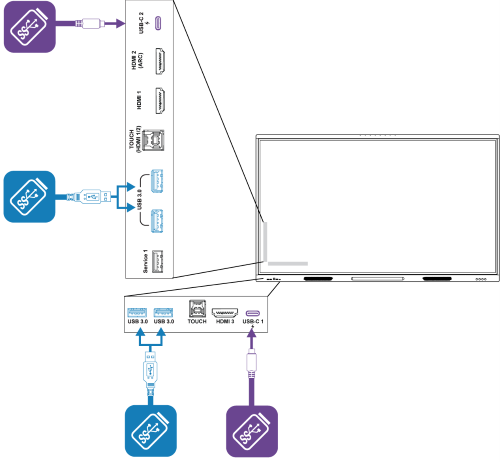
This table shows the supported USB speeds for each input:
Input | USB 3.2 Gen 1 Type-A | USB Type-C |
|---|---|---|
USB-C 1 | Hi-Speed | Hi-Speed |
USB-C 2 | Hi-Speed | Hi-Speed |
HDMI 1 | SuperSpeed | SuperSpeed |
HDMI 2 | SuperSpeed | SuperSpeed |
HDMI 3 | SuperSpeed | SuperSpeed |
OPS accessory slot | SuperSpeed | SuperSpeed |
Notes
Hi-Speed = 480 Mbps
SuperSpeed = 5 Gbps
You can charge devices using the display’s USB Type-C receptacles:
Receptacle
Location
Maximum charging capacity
USB-C In 1
Front connector panel
100 W
USB-C In 2
Side connector panel
100 W
Connecting an external display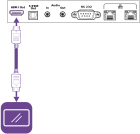
You can connect an external display using the HDMI Out connector on the connector panel. The external display will show the same image. This is useful when you’re using the display in an auditorium or other large space where it would be beneficial to have a second display.
Connecting an external video source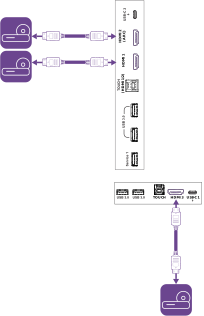
You can connect an external video source, such as a DVD player, media box, or cable box, to your display using an HDMI cable and to any of the HDMI connectors on the display’s connector panels. To view the source content, switch to the connected HDMI input.
Connecting an external audio system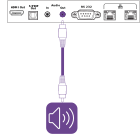
The display includes two integrated speakers and a subwoofer, designed to provide sound at the front of a room.
You might want to connect an external audio system if you’re providing sound in a larger space.
You can connect the display to an external audio system using the Stereo 3.5 mm Out connector. This disables the display’s internal speakers.
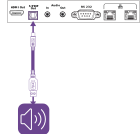
In addition to the Stereo 3.5 mm Out connector, the display provides an optical Sony/Philips Digital Interface (S/PDIF) Out connector. S/PDIF is a digital audio transmission medium. You need an audio system that has an S/PDIF input to decode this connection to analog. Most external sound bars include an S/PDIF connector.
Note
The S/PDIF audio is a fixed-volume output. Adjusting the volume of the display’s speakers does not affect the S/PDIF output.
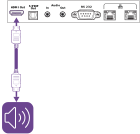
You can also connect an external audio system to the display using the HDMI Out connector on the bottom connector panel.
Note
The audio is a fixed-volume output. Adjusting the volume of the display’s speakers does not affect the HDMI output.
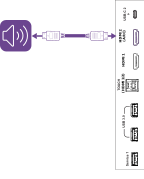
If you have an external audio system with HDMI ARC (Audio Return Channel) or eARC (Enhanced Audio Return Channel), you can output the display’s audio to the audio system by connecting the display’s HDMI 2 (ARC) connector on the side connector panel to the HDMI Out connector on the audio system’s receiver.
Connecting room control systemsA room control system enables users to control a room’s lighting, audio system, and possibly, the display. Some installations may require you to integrate the display with a room control system.
You can use the display’s RS-232 connector to connect a third-party external control system to the display.
Note
SMART Board interactive displays are not compatible with centralized remote control systems, such as a universal remote control.